

5 breathing exercises for pregnancy: step by step
It’s 2 a.m. and your mind won’t stop. You’re thinking about your next OB appointment, the hospital bag, whether you ate enough iron today. Your belly feels heavy, finding a comfortable position seems impossible, and on top of it all you feel short of breath. Sound familiar?
During pregnancy, a lot of things are out of your control: the hormones, the physical changes, your body’s timeline. But there’s one thing you can always manage: how you breathe. And it turns out the way you breathe has a direct impact on your anxiety levels, the quality of your sleep, and even how you handle contractions during labor.
In our article on how to improve memory during pregnancy, we mentioned controlled breathing as a technique to lower cortisol (technique #10). Now let’s go deeper into five specific exercises you can start practicing today.

Why breathing matters during pregnancy
When you breathe slowly and deeply, you activate the parasympathetic nervous system, which is responsible for telling your body “we’re safe, we can relax.” This lowers cortisol (the stress hormone) and reduces heart rate.
Conscious breathing is one of the most accessible tools for reducing stress during pregnancy. According to research by Dr. Shilpa Babbar, an OB-GYN specializing in prenatal well-being, breathing techniques can reduce perceived stress by 25-40% in pregnant women.
The benefits go beyond feeling calmer:
- Better sleep: slow breathing before bed signals your brain that it’s time to rest.
- Less anxiety: it interrupts the cycle of racing thoughts by activating the relaxation response.
- Pain management during labor: breathing techniques are a core part of labor preparation because they help manage contractions and keep both you and the baby oxygenated.
- Relief from shortness of breath: in the third trimester, the uterus presses against the diaphragm and breathing can feel harder. Certain techniques help you make the most of each inhale.
5 breathing exercises step by step
1. Diaphragmatic breathing
This is the foundation of all other techniques. Learning to breathe with your diaphragm (rather than breathing only with your chest) allows more air into your lungs and activates the relaxation response more effectively.
Good for: general calm, better sleep, releasing muscle tension.
How to do it:
- Sit in a comfortable position or lie on your side with a pillow between your legs.
- Place one hand on your chest and the other on your belly.
- Inhale slowly through your nose, letting your belly expand (the hand on your belly should rise while the one on your chest stays still).
- Exhale slowly through your mouth, feeling your belly lower.
- Repeat for 5 to 10 minutes.
When to use it: every day, ideally in the morning when you wake up or before bed. It’s a good starting point if you’ve never practiced conscious breathing before.
2. 4-7-8 breathing
This technique was popularized by Dr. Andrew Weil and works as a natural sedative for the nervous system. The timing of the inhale, hold, and exhale forces the body to slow down.
Good for: falling asleep, calming acute anxiety.
How to do it:
- Sit or lie down comfortably.
- Inhale through your nose for a count of 4.
- Hold your breath for a count of 7.
- Exhale completely through your mouth for a count of 8.
- Repeat 3 to 4 cycles.
When to use it: before bed (it’s especially effective for insomnia) or when you feel anxiety spike suddenly.
3. Box breathing
Used by fighter pilots and surgeons to stay calm under pressure. It consists of four equal phases that create a predictable rhythm to quiet the mind.
Good for: focusing the mind, stopping racing thoughts, regaining concentration.
How to do it:
- Sit with your back straight and your feet flat on the floor.
- Inhale through your nose for a count of 4.
- Hold your breath for a count of 4.
- Exhale through your mouth for a count of 4.
- Hold your lungs empty for a count of 4.
- Repeat 4 to 6 cycles.
When to use it: when your mind won’t stop and you need to break the thought loop. It also works well before a work meeting or a medical appointment that makes you nervous.
4. Pursed lip breathing
Especially useful in the third trimester, when the uterus grows and presses against the diaphragm, making breathing feel harder. This technique slows down exhalation and helps empty the lungs more fully.
Good for: relieving the sensation of breathlessness, improving oxygenation.
How to do it:
- Sit in a comfortable position with relaxed shoulders.
- Inhale slowly through your nose for a count of 2.
- Purse your lips as if you were about to blow out a candle (but gently).
- Exhale through your pursed lips for a count of 4, letting the air out slowly and in a controlled way.
- Repeat for 2 to 5 minutes.
When to use it: whenever you feel short of breath, after climbing stairs, or when your belly makes it hard to take a deep breath.
5. Birth breathing
This technique is used during contractions and the pushing phase. It involves a deep inhale followed by a long, relaxed exhale, as if you were trying to fog up a mirror.
Good for: managing contraction pain, staying oxygenated during labor, relaxing the pelvic floor.
How to do it:
- Inhale deeply through your nose, filling your belly.
- Exhale slowly through your mouth with a relaxed jaw and open lips (imagine you’re fogging up a mirror).
- With each exhale, let your shoulders, jaw, and pelvic floor soften.
- Repeat continuously through each contraction.
When to use it: start practicing in the last weeks of pregnancy so the pattern becomes automatic when the time comes. During labor, use it with every contraction.
⚠️Important precaution
Avoid holding your breath for extended periods or hyperventilating. If you feel dizzy, experience blurred vision, or notice tingling in your hands, return to normal breathing. These techniques should feel comfortable, never forced.
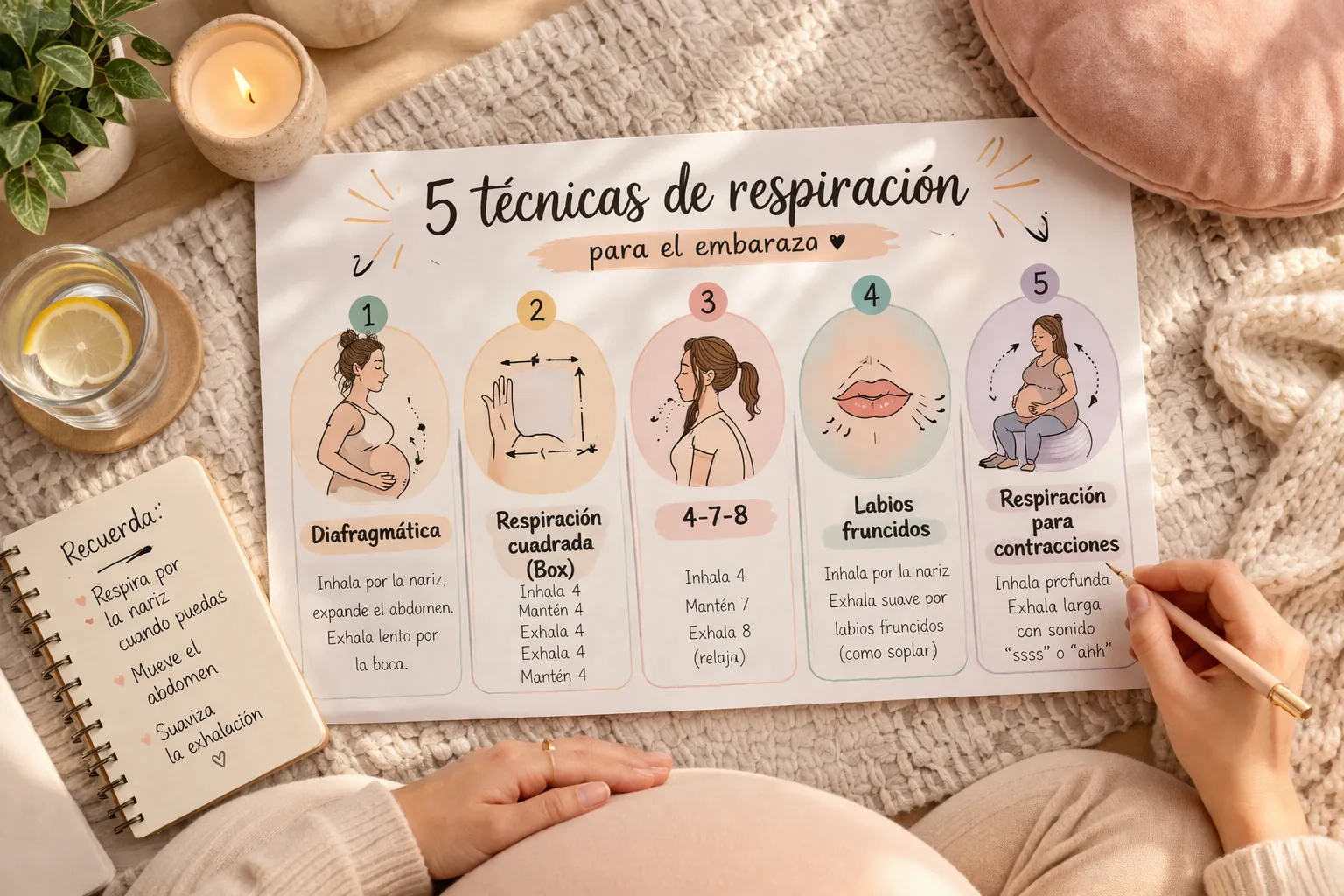
When to use each technique
| Situation | Recommended technique |
|---|---|
| General anxiety, everyday tension | Diaphragmatic breathing |
| Can’t fall asleep | 4-7-8 breathing |
| Racing thoughts, lack of focus | Box breathing |
| Shortness of breath (third trimester) | Pursed lip breathing |
| Contractions and labor | Birth breathing |
You don’t need to master all five at once. Start with diaphragmatic breathing (it’s the foundation) and then add whichever one fits what you need right now.
Memobebe helps you remember everything
Try for freeFrequently asked questions
Is it safe to hold your breath during pregnancy?
Brief holds (like the 7 seconds in the 4-7-8 technique or the 4 seconds in box breathing) are safe for most pregnant women with uncomplicated pregnancies. The key is that you should not feel any discomfort. If you have a cardiovascular or respiratory condition, check with your doctor before practicing techniques that involve breath retention.
How long should I practice each day?
Five to 10 minutes daily is enough to notice changes in your stress levels and sleep quality. Consistency matters more than duration: it’s better to practice 5 minutes every day than 30 minutes once a week. You can weave it into moments that are already part of your routine, like when you wake up, before lunch, or at bedtime.
Can I use these techniques during labor?
Yes, and it’s actually one of the best things you can do to prepare. Birth breathing (technique #5) is designed specifically for use during contractions, but diaphragmatic breathing and 4-7-8 breathing also help between contractions to recover your calm. Many midwives and OB-GYNs recommend practicing these techniques in the final weeks of pregnancy so that the response becomes automatic on delivery day.
Breathing is something you do thousands of times a day without thinking about it. But giving it a few minutes of conscious attention can change how you feel throughout your pregnancy. You don’t need equipment, it doesn’t cost anything, and you can start right now.
If you want to keep taking care of your well-being during this stage, check out our article on pregnancy brain and how to handle forgetfulness. Visit our wellness section for more practical guides.
Related articles
No-cook summer meals for pregnancy
7 no-cook summer meals for pregnancy: fresh, listeria-safe, and built for the hottest days when the oven stays off.
Anti-gas dinners in the third trimester of pregnancy
6 gentle dinners to ease gas and bloating in late pregnancy: what to avoid, how to combine, and why onion and unpeeled legumes don't help.
10 one-handed snacks for nighttime nursing
10 snacks you can eat with one hand while nursing at night: nutritious, easy to prep ahead, and built for the 3 a.m. feed.