

What to eat going back to work while breastfeeding
Going back to work while you’re still breastfeeding has a blind spot almost no one talks about: the food. You’ll find a thousand guides on how to organize pumping, schedules, and milk storage, and another thousand on breastfeeding nutrition. But the intersection of the two (what to eat and how to organize it when you’re out of the house for eight hours and still nursing) gets left in a no-man’s-land.
That’s exactly where it falls apart. Between the workday, the commute, and your pumping sessions, it’s easy to finish the day having had a coffee and whatever you grabbed. On top of everything else your body is doing day to day, breastfeeding adds about 400-500 kcal a day (a reference figure from the Institute of Medicine, 2005), and if you don’t cover them, you feel it in your energy before you feel it in your supply. This guide is practical: what to prep ahead, what to pack, and how not to run out of fuel.
ℹ️This is a general guide
The amounts and pointers are approximate and depend on your body, activity, and situation. It isn’t a substitute for your healthcare provider: if your midwife, lactation consultant, or nutritionist told you something different, always follow their advice over this guide.
The 3 things that actually matter
Before the how, the what. When you’re breastfeeding and short on time, prioritize this:
- Steady, sufficient energy. This isn’t the moment for restrictive diets. Eating less doesn’t “clean up” your milk, it just leaves you running on fumes. Aim for meals that combine whole carbs, protein, and good fats so the energy lasts.
- Hydration. Breastfeeding makes you thirsty. The easiest rule: a glass of water every time you sit down to nurse or pump. Keep one on your desk and another in your pump bag.
- Iron and calcium, without obsessing. Postpartum usually leaves iron stores low. Include sources daily, but not in the same meal as coffee (which interferes with absorption). Calcium is just as important, but better in meals that aren’t your iron meals.
The system: Sunday batch cooking
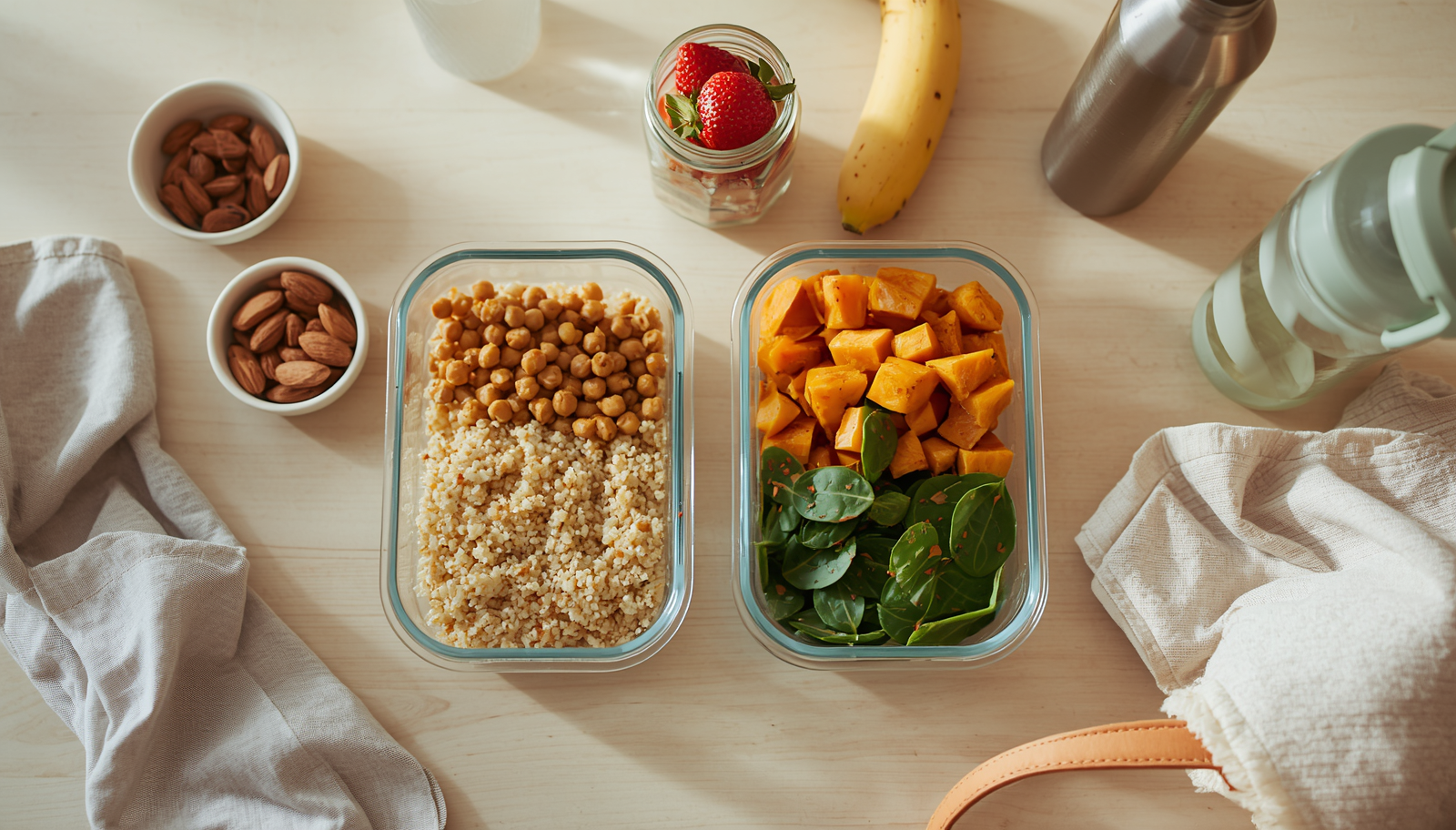
The key isn’t cooking better, it’s cooking once for several days. Set aside an hour on the weekend to prep a base. The idea isn’t to have the finished dish ready, it’s to have the “building blocks” so you can assemble it in two minutes.
| What to prep | Yields | How to store it |
|---|---|---|
| One cooked legume (lentils, chickpeas) | 4-5 servings | Container in the fridge (4 days) or portioned in the freezer |
| One whole grain (rice, quinoa, couscous) | 4-5 servings | Fridge, 3-4 days |
| Sheet-pan roasted vegetables (sweet potato, pumpkin, zucchini) | 4 servings | Fridge, 4 days |
| A vegetable soup | 4-6 servings | Portioned in the freezer |
| Your pick of protein: tofu, hard-boiled eggs, chicken, or salmon | 3-4 servings | Fridge, 3 days |
| Washed and cut fruit | Several days | Glass jars in the fridge |
With that base, lunch becomes a scoop of grain + a scoop of legume or protein + roasted veg + a drizzle of oil. Three minutes and you have a complete plate.
💡The two-container rule
Always prep two containers at once: today’s and tomorrow’s. When an impossible day hits, tomorrow’s is already done and you don’t end up at the vending machine. It’s the small adjustment that holds the whole system up in messy weeks.
What to pack for snacks (and to eat while pumping)
The gaps between meals are where breastfeeding falls apart. Always have something within reach that you can eat fast, even with one hand while you’re pumping:
- Unsalted nuts (almonds, walnuts): dense energy and plant iron.
- Whole or cut fruit (banana, mandarin, grapes): hydration and natural sugars.
- Hummus with carrot sticks or whole-grain bread: legumes, easy to transport.
- Plain yogurt or a calcium-fortified plant drink.
- Avocado toast or a handful of olives: good fat that fills you up.
- Homemade oat cookies or a piece of whole-grain bread with peanut butter.
If your pumping window lines up with hunger, leave a snack ready that you can eat one-handed. I go deeper on this in 10 one-handed snacks for night nursing, and they work the same way at the office.
A normal day, without overcomplicating it
This isn’t a rigid plan, it’s an example of how the pieces fit:
| Moment | Idea |
|---|---|
| Breakfast (at home) | Oats with plant milk, banana, and nuts. Or whole-grain toast with avocado and egg. |
| Mid-morning (at work) | Fruit + a handful of almonds. Water. |
| Lunch (packed) | Quinoa + chickpeas + roasted veg + oil. Or the soup from the freezer + toast with hummus. |
| Pumping / afternoon snack | Yogurt or oat cookies. A glass of water as you sit down. |
| Dinner (at home) | Something warm and simple: soup + an omelet, or baked fish with sweet potato. |
Dinner at home is a good moment for whatever didn’t make it into the day: a serving of greens, fish a couple of times a week, or that legume you didn’t get to at lunch.
How to keep track of things on so little sleep
Going back to work, breastfeeding, and sleeping in fragments is a lot at once. It’s easy to lose track of when you last pumped, how much you stored, or whether you’ve eaten anything decent. A notebook works, but between meetings and feeds it usually becomes one more thing you forget about.
In memobebe you can log feeds, pumping sessions, and how you’re feeling in the same place, with one tap. The point isn’t to keep tabs on you: it’s so when you wonder “when was the last pumping session?” or “have I been eating like garbage for days?”, you have the answer without rebuilding it from memory. If you want the full picture of daily tracking, I cover it in how to track your baby without losing your mind.
Frequently asked questions
Do I need to eat more when I go back to work if I’m still breastfeeding?
Breastfeeding adds about 400-500 kcal a day, whether you’re back at work or not. What changes with the workday isn’t how much you need, it’s how easy it is to never get around to eating it. That’s why the trick is prep, not forcing yourself to eat “more.”
What do I pack if I don’t have time to cook on the weekend?
Lean on shortcuts without guilt: canned chickpeas, well rinsed, frozen sautéed vegetables, precooked whole-grain rice, canned fish, hard-boiled eggs, fruit, and nuts. A plate of canned chickpeas with tomato, tuna, and olive oil is complete and takes five minutes.
Will coffee dry up my milk or hurt the baby?
Up to about 200-300 mg of caffeine a day (1-2 small cups) is considered compatible with breastfeeding. It won’t dry up your milk. Caffeine does pass into breast milk in small amounts, and in very young or sensitive babies it can disrupt their sleep or leave them more irritable, so if you notice your baby more wired after a feed, try cutting back and watch. Keep it separate from iron meals, too, since it interferes with iron absorption right when postpartum tends to leave your stores low.
Do I have to drink a ton of water to make more milk?
Drinking more than you need doesn’t increase supply, but getting dehydrated will give you a headache and leave you wiped out. The rule that actually works: a glass of water every time you sit down to nurse or pump. That covers it without counting liters.
Can I diet to lose the pregnancy weight while breastfeeding and working?
This isn’t the moment for hard restriction. Combining a calorie deficit with breastfeeding and a workday usually adds up to exhaustion. If you’re worried about weight, talk it through with your provider, but for now the priority is steady, sufficient energy.
Going back to work without dropping the breastfeeding ball is, more than anything, an organization problem: an hour of batch cooking on Sunday and a couple of snacks always within reach hold up the rest of the week. It isn’t about eating perfectly, it’s about not running out of fuel exactly when you need it most. If you want a tool to keep tabs on the moving parts (feeds, pumping, how you’re feeling), memobebe is built for this.
Find more on breastfeeding in our breastfeeding section.
Related articles
10 one-handed snacks for nighttime nursing
10 snacks you can eat with one hand while nursing at night: nutritious, easy to prep ahead, and built for the 3 a.m. feed.
Breastfeeding recipes if your baby has colic
14-day elimination plan, what the evidence actually says, neutral recipes, and how to track your baby's reactions without losing your mind.
Cluster feeding: what it is and why it's totally normal
What cluster feeding is, when it happens, how long it lasts, and why it's a normal part of your baby's development. No alarmism.